What secrets hide in the universe’s darkness?
What secrets hide in the universe’s darkness?
When we look up at the night sky, we think we’re seeing the universe. Stars, galaxies, glowing nebulae scattered across a vast black canvas. But here’s the unsettling truth: almost everything we see is the minority. The bright, visible universe makes up only a tiny fraction of what actually exists.
The rest is darkness.
Not empty darkness.
Not nothingness.
But a deep, silent, unseen presence that outweighs everything we know.
So the real question isn’t what’s out there in the light.
It’s this:
What secrets hide in the universe’s darkness?
And why does it feel like the darkness is doing most of the work?
Darkness Is the Rule, Not the Exception
Modern cosmology tells us something shocking. Roughly 95% of the universe is invisible. It’s made of things we can’t see, touch, or directly measure.
- Dark matter holds galaxies together
- Dark energy is accelerating the expansion of the universe
- Ordinary matter, stars, planets, people, everything familiar, makes up only about 5%
That means the universe we experience is built on top of something hidden.
Imagine living in a house where 95% of the structure is invisible, yet somehow everything stands because of it.
That’s our universe.
And we barely understand it.
Dark Matter, The Invisible Sculptor
Dark matter doesn’t emit light. It doesn’t reflect light. It doesn’t absorb light. But it has gravity, and that gravity shapes everything.
Without dark matter:
- Galaxies would tear themselves apart
- Stars would drift away
- Cosmic structures would never form
In other words, nothing would exist the way it does now.
Dark matter is like an unseen skeleton holding the universe upright.
And here’s the creepy part. We don’t know what it is.
Is it a particle?
A field?
A shadow of another dimension?
A leftover from an earlier universe?
Some theories suggest dark matter could be evidence of hidden dimensions intersecting with ours. Others propose it might be the gravitational influence of matter existing in a parallel reality.
What if the darkness isn’t empty?
What if it’s crowded, just out of reach?
Dark Energy, The Silent Force Pushing Everything Apart
If dark matter pulls things together, dark energy does the opposite. It pushes the universe outward, faster and faster.
The universe isn’t just expanding. It’s accelerating.
Something is telling space itself to stretch.
Dark energy makes up about 68% of the universe, and yet we have no idea what it is, where it comes from, or why it exists.
It doesn’t behave like matter.
It doesn’t behave like energy as we know it.
It acts more like a property of space itself.
Almost as if the universe is being pulled toward something unseen.
Or away from something.
What if dark energy is the universe leaking into something else?
Another reality?
Another phase of existence?
Black Holes, Darkness with Teeth
Black holes are the most literal form of cosmic darkness. Regions where gravity is so intense that not even light escapes.
But black holes are not just voids. They are information traps.
According to modern physics, everything that falls into a black hole is not destroyed. Its information is stored, encoded on the surface of the event horizon.
That means black holes might be:
- Cosmic hard drives
- Memory vaults of the universe
- Records of everything that ever existed
Some theories suggest black holes could even be gateways, connecting distant regions of space or entirely different universes.
If so, the darkness inside a black hole may not be an ending, but a passage.
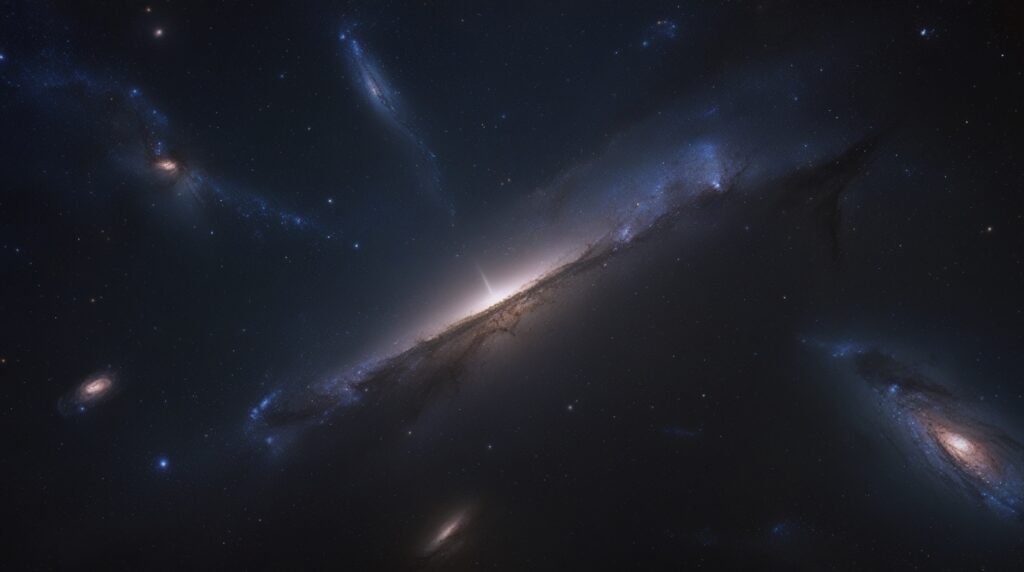

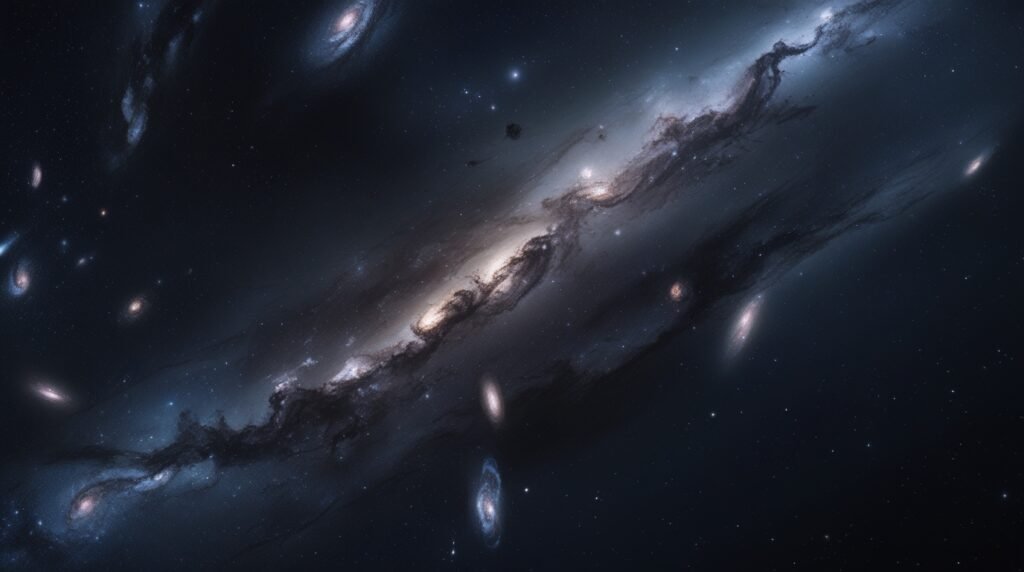
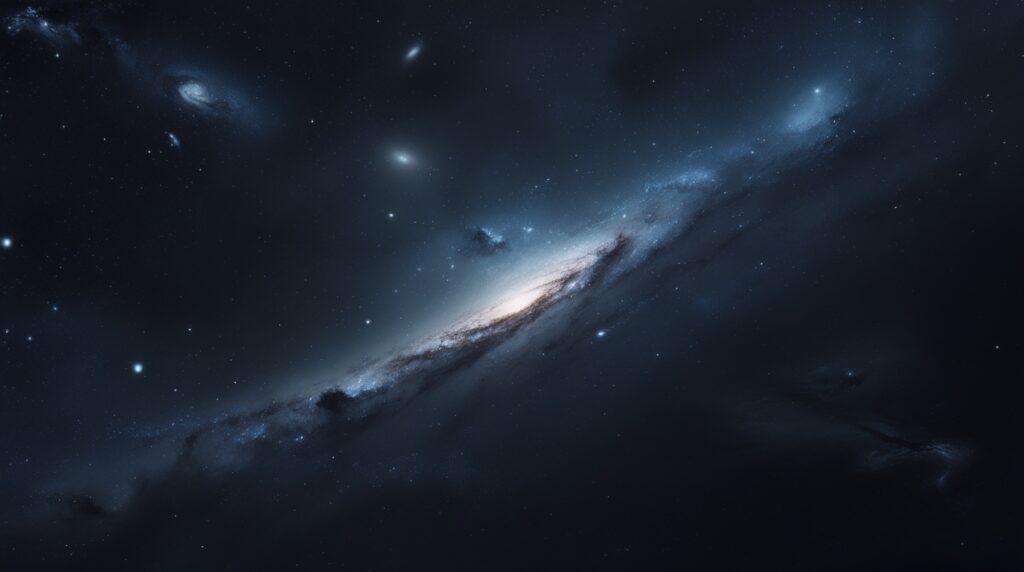
The Darkness Between Galaxies
Most of the universe isn’t filled with stars. It’s filled with vast, cold, silent voids stretching millions of light-years.
These cosmic voids aren’t random. They have structure. Shape. Pattern.
Some researchers have noticed that galaxies arrange themselves around these voids like foam bubbles, as if something invisible is pushing them into place.
What if these voids aren’t empty at all?
What if they are regions where something else exists, but not in a form we can detect?
Perhaps:
- Exotic particles
- Other-dimensional matter
- Different physical laws
- Or remnants of previous universes
The darkness between galaxies might be the most important part of the universe, not the least.
Darkness and Consciousness
Here’s where things get strange in a different way.
Human consciousness seems oddly drawn to darkness. We associate it with fear, mystery, depth, and the unknown. But also with creativity, dreams, and imagination.
When there’s no light, the mind fills the space.
Could it be that the universe’s darkness is similar?
A canvas of potential rather than emptiness?
Some philosophers and physicists have speculated that consciousness itself might arise from the same unknown layer as dark matter and dark energy.
If so, the darkness isn’t just physical.
It’s foundational.
Ancient Myths Knew the Darkness Mattered
Long before telescopes, ancient cultures spoke of cosmic darkness as the source of creation.
- In Egyptian mythology, the universe emerged from Nun, the dark, infinite waters
- In Hindu philosophy, Brahman exists beyond light and form
- In Greek myth, Chaos was the dark void before creation
- In many traditions, darkness comes before light
They didn’t see darkness as evil or empty.
They saw it as the womb of existence.
Maybe they were closer to the truth than we think.
Could the Darkness Be Watching?
This is speculative, but unsettling.
If most of the universe exists in a form we can’t see or measure, what are the chances that it’s entirely inert?
What if:
- Intelligence doesn’t require light
- Awareness doesn’t need matter
- Life can exist as patterns of gravity, energy, or information
If such forms of existence exist, they would be invisible to us, yet everywhere.
We wouldn’t see them.
But they might see us.
Key Points
- Over 95% of the universe is invisible and unknown
- Dark matter shapes galaxies without being seen
- Dark energy drives cosmic expansion for unknown reasons
- Black holes store information, not destruction
- Cosmic voids may hide unseen structures or dimensions
- Darkness might be a field of potential, not emptiness
- Ancient myths viewed darkness as the source of creation
Our Thoughts
Maybe the universe’s greatest secrets aren’t hidden in distant stars or brilliant explosions, but in the quiet, endless darkness between them.
Maybe the darkness isn’t the absence of something.
Maybe it’s the presence of everything we don’t yet understand.
And maybe one day, when we finally learn how to look into the dark without fear, we’ll realize the universe was never empty at all.
It was just waiting.