What if the void between galaxies is alive?
What if the void between galaxies is alive?
When we imagine the universe, we picture galaxies blazing with stars, nebulae glowing in color, black holes tearing light apart. But almost none of the universe looks like that.
Most of it is void.
Not empty space in the casual sense, but enormous stretches between galaxies, millions of light-years wide, where there are no stars, no planets, no obvious structure. Just darkness, cold, and silence.
And yet, those voids make up most of the universe.
So here is the unsettling question we rarely ask seriously,
what if the void between galaxies is alive?
Not alive like animals.
Not alive like plants.
But alive in a way that fits the scale, slowness, and silence of the cosmos.
The Void Is Not Truly Empty
The word “void” tricks us. It suggests nothingness. But physics tells a different story.
Even in the emptiest regions of space, there is still:
- Quantum energy
- Virtual particles popping in and out of existence
- Background radiation
- Gravitational influence
- Dark matter and dark energy
Space itself has structure. It can stretch, curve, ripple, and expand. That alone means the void is not absence. It is something.
And where there is something, the possibility of complexity exists.
Life Does Not Have to Look Like Us
We define life based on Earth, because Earth is all we know.
Cells.
Metabolism.
Growth.
Reproduction.
But these definitions are local, not universal.
At its core, life is often described as something that:
- Maintains structure over time
- Responds to its environment
- Influences surrounding systems
- Processes information
- Persists
By that definition, the cosmic void starts to look less lifeless.
The void shapes how galaxies form.
It guides the flow of matter along cosmic filaments.
It expands, stretches, and evolves with the universe.
What if the void is not passive space, but an active medium?
The Cosmic Web Looks Suspiciously Biological
When astronomers map the universe at its largest scale, they see something eerie.
Galaxies are not scattered randomly. They form a vast cosmic web, long filaments of matter surrounding enormous voids, like bubbles in foam or cells in tissue.
This structure looks disturbingly similar to:
- Neural networks
- Fungal mycelium
- Blood vessels
- Cellular membranes
The voids are not empty gaps. They are the spaces between the strands, defining the structure itself.
In biology, empty space between cells is not meaningless. It allows communication, pressure, balance, and flow.
What if the universe is organized the same way?
Life on a Timescale We Cannot Feel
One reason we dismiss the idea of a living void is speed.
Life, as we know it, moves quickly. Breathing, growth, death.
But cosmic processes operate on timescales of millions or billions of years.
If the void were alive:
- A single “reaction” might take a million years
- A single “thought” might span a galaxy
- A single “change” might outlast civilizations
To us, it would appear completely inert.
Like watching a mountain and concluding it cannot move.
Dark Energy as a Sign of Activity
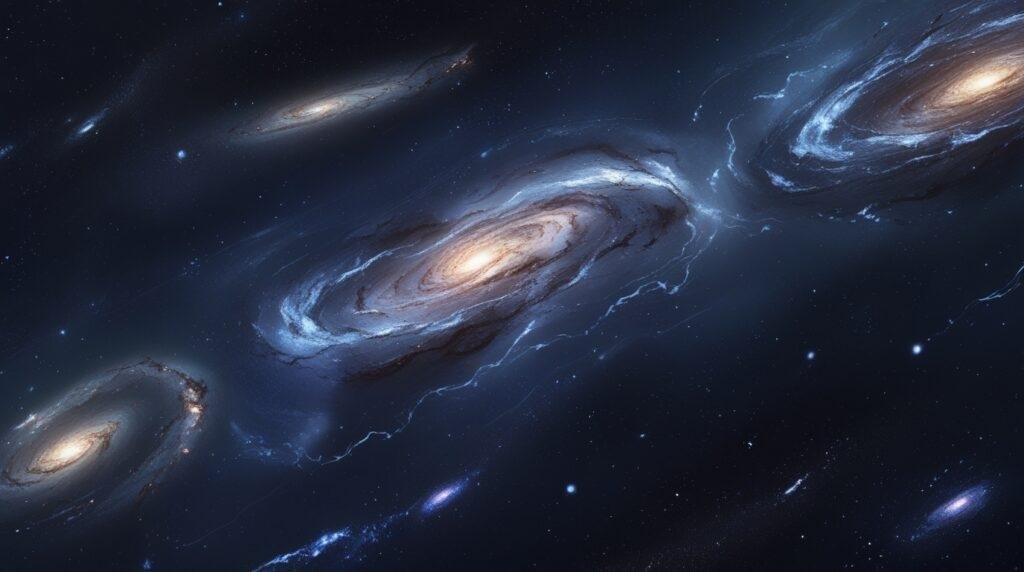
The void is where dark energy dominates.
Dark energy is strongest in empty space, pushing galaxies apart and accelerating expansion. It does not clump like matter. It grows as space grows.
That behavior is strange.
What if dark energy is not a force acting on the void, but the void acting on the universe?
What if the expansion of space is not random, but a process, a behavior, something the void does?
If the void were alive, expansion could be analogous to growth, respiration, or regulation at a cosmic scale.
A Life Form Made of Space Itself
Imagine a form of life that does not live in space, but is space.
No body.
No center.
No single location.
Instead:
- It exists as a field
- It responds through gravity and expansion
- It shapes matter without touching it
- It evolves by rearranging spacetime
Such a life form would be everywhere and nowhere at once.
We would not see it.
We would live inside it.
And we would call its behavior physics.
Why We Would Never Recognize It
Human perception is tuned for survival, not truth.
We notice:
- Movement at our scale
- Heat and light
- Sound and pressure
- Patterns that resemble ourselves
The void offers none of these.
It does not glow.
It does not speak.
It does not move quickly.
If something were alive there, it would not announce itself. It would not need to.
Just as bacteria had no idea humans existed until microscopes, we may lack the conceptual tools to even define cosmic life.
Ancient Intuitions About Living Emptiness
Interestingly, ancient philosophies did not see emptiness as dead.
- Taoism describes the void as active and generative
- Buddhist philosophy sees emptiness as full of potential
- Ancient Greek thinkers spoke of a living aether
- Indigenous cosmologies often describe space as conscious
Modern science dismissed these ideas as symbolic.
But now, science is discovering that emptiness is anything but empty.
Could the Void Be Aware?
Awareness does not have to resemble thought.
A thermostat responds to temperature.
An ecosystem responds to imbalance.
A star responds to gravity.
Awareness at a cosmic scale could be subtle, slow, and entirely impersonal.
Not a mind with intentions, but a system that:
- Adjusts
- Regulates
- Persists
- Maintains large-scale order
If the void were aware in this sense, it would not care about individuals, planets, or species.
It would care about structure.
Key Points
- The void makes up most of the universe
- Empty space is filled with energy, fields, and structure
- The cosmic web resembles biological systems
- Dark energy dominates the void and drives expansion
- Life may exist on timescales far beyond human perception
- A life form made of spacetime would look like physics to us
- Ancient philosophies viewed emptiness as active, not dead
Our Thoughts
If the void between galaxies is alive, then the universe is not a stage with actors moving across it.
It is the organism.
Stars are its sparks.
Galaxies are its organs.
The void is its body.
And we, tiny and brief, exist inside a system so vast and slow that it does not notice us any more than we notice cells in our bones.
That idea is humbling, unsettling, and strangely comforting.
Because it means the universe is not cold or empty.
It is just alive in a way we are not yet ready to understand.