What if the universe has a dark boundary?
What if the universe has a dark boundary?
We like to imagine the universe as endless. No walls. No edges. Just space stretching forever in every direction. It’s a comforting idea, almost poetic.
But comfort is not evidence.
The truth is, we don’t actually know if the universe is infinite. We assume it is because edges make us uneasy. Edges imply limits, and limits imply something beyond them.
So let’s ask the question we usually avoid:
What if the universe has a dark boundary?
Not a wall you could crash into.
Not a visible edge glowing in space.
But a boundary made of darkness, silence, and something fundamentally different from the reality we know.
Why the Idea of a Boundary Feels Wrong
A boundary feels wrong because we imagine space like an empty box. If there’s an edge, what’s outside the box?
But space may not work that way.
The universe might not be an object sitting inside something else. It could be a self-contained system, with limits that don’t behave like physical barriers.
Think of the surface of the Earth. It has no edge you can fall off, yet it is finite. You can travel forever without hitting a wall, and still be confined.
The universe could be similar. Finite, but unbounded.
Or it could be something stranger.
Darkness at the Limits of Reality
When astronomers look as far as they can, they don’t see a neat ending. They see darkness.
Beyond a certain distance, light hasn’t had enough time to reach us since the universe began expanding. This creates what we call the observable universe.
But beyond that horizon is not confirmed emptiness. It is simply unknown.
Now here’s the unsettling thought.
What if that darkness is not just distance, but difference?
What if reality itself changes beyond a certain boundary, and darkness is the only thing that leaks through?
A Boundary Made of Physics, Not Matter
If the universe has a boundary, it would not be made of atoms or energy the way walls are.
It would likely be a boundary of laws.
Beyond it:
- Time may not behave the same way
- Space may not exist as dimensions
- Cause and effect may not apply
- Matter may not hold together
In that case, the boundary would not stop objects.
It would stop reality.
Anything approaching it would not hit something. It would lose definition, like a sentence dissolving before the last word is written.
The Universe May Be Expanding Into Something
The universe is expanding. Not galaxies moving through space, but space itself stretching.
That raises an uncomfortable question.
What is it expanding into?
Physicists often say it’s not expanding into anything, that space creates more space. But that explanation avoids the deeper discomfort rather than resolving it.
What if expansion is pushing reality toward a limit?
What if dark energy, the force accelerating expansion, is not random but directional, pressing the universe outward toward a boundary?
If so, the universe is not drifting aimlessly.
It is moving toward an edge we cannot see.
A Boundary Where Time Ends
Time is deeply tied to space. Change requires space to happen in.
If the universe has a boundary, time may not survive past it.
At the dark edge:
- Events may not sequence
- Memory may not persist
- Duration may lose meaning
It would not be a moment after the universe.
It would be outside of moments entirely.
From our perspective, it would look like eternal darkness.
From a deeper perspective, it might be where time itself stops being relevant.
Dark Energy as a Clue
Dark energy grows stronger as space expands. It does not dilute. It dominates emptiness.
That is strange behavior.
Most forces weaken as space grows. Dark energy does the opposite.
What if dark energy is not a force within the universe, but a pressure from beyond it?
A boundary condition pushing inward.
Like water pressure against the walls of a container.
If so, dark energy may be the universe responding to its own limits.
Why We Can’t See the Boundary
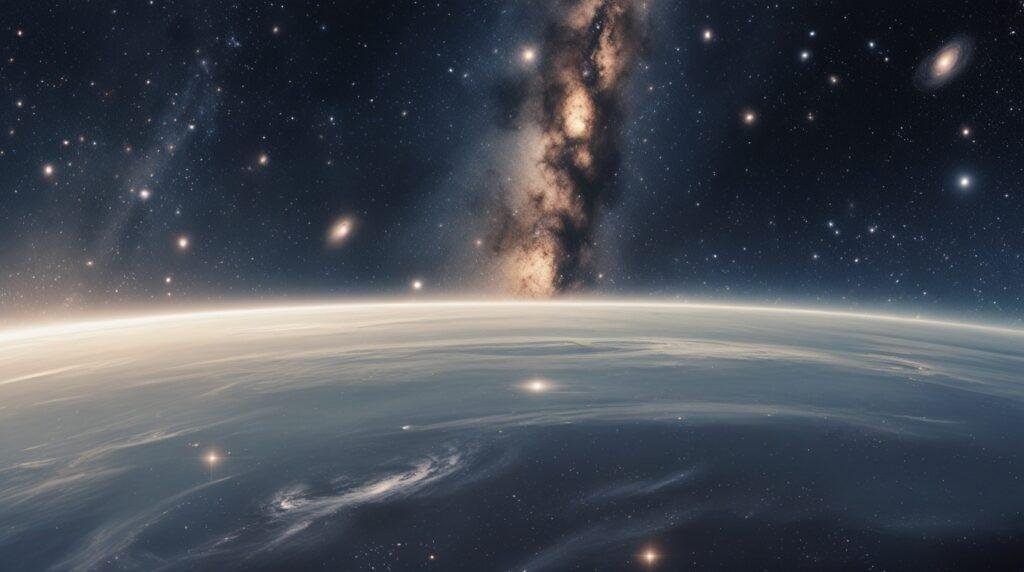
A true boundary would be impossible to observe directly.
You cannot see the edge of reality from inside reality, the same way a character in a story cannot see the edge of the page.
Light approaching the boundary might:
- Redshift into nothing
- Lose coherence
- Stretch into silence
What reaches us is not information, but absence.
That absence is what we call darkness.
Could the Boundary Be Alive or Aware?
This moves into speculation, but it is worth considering.
If the universe is a system, boundaries often regulate systems. Cell membranes regulate cells. Skins regulate organisms. Horizons regulate black holes.
What if the universe’s boundary is not passive?
Not conscious in a human sense, but responsive. Adaptive. Limiting expansion, shaping structure, maintaining balance.
A boundary that doesn’t think, but functions.
If so, the universe is not free-floating.
It is contained.
Black Holes as Local Boundaries
Black holes may offer a clue.
They are boundaries where space and time fail. Where information appears to vanish. Where reality becomes inaccessible.
Some theories suggest black holes are connected to other regions, or even other universes.
If that’s true, then black holes may be micro-boundaries, local versions of something much larger.
The universe itself may have a horizon that behaves the same way, just at an unimaginable scale.
Ancient Intuitions About Cosmic Limits
Across cultures, ancient myths speak of:
- A firmament
- A cosmic ocean
- A veil beyond the stars
- A darkness outside creation
These ideas are often dismissed as pre-scientific guesses. But intuition often reaches truths before language or mathematics can describe them.
Perhaps humans have always sensed that reality has limits, even if we could not define them.
What Lies Beyond the Dark Boundary?
This is the question that makes the idea truly uncomfortable.
Beyond the boundary might be:
- Nothing at all
- Another universe
- A higher-dimensional structure
- Raw potential without form
- A different phase of existence
Or something so unlike reality that the question itself stops making sense.
The boundary may not separate “something” from “something else”.
It may separate existence from non-existence.
Key Points
- We do not know whether the universe is infinite
- Darkness dominates the limits of what we can observe
- A boundary could be made of laws, not matter
- Dark energy may hint at a cosmic limit
- Time may not exist beyond such a boundary
- Black holes may be local examples of boundary behavior
- The universe may be a contained system, not endless
Our Thoughts
If the universe has a dark boundary, then reality is not absolute.
It exists under conditions.
It holds together within limits.
Beyond those limits, there is not chaos, but inapplicability. A place where our concepts, time, space, matter, meaning, simply stop working.
That idea is unsettling, but also clarifying.
It reminds us that existence is not guaranteed everywhere.
It is something the universe allows, locally, briefly, and beautifully.
And beyond the darkness at the edge, whatever exists there, if anything does, is not waiting for us.
It simply is, or perhaps, does not need to be at all.