What if mermaids once lived in our oceans?
What if Mermaids Once Lived in Our Oceans?
There’s something haunting about the idea of mermaids. Half human, half fish, mysterious and beautiful, they’ve haunted the edges of our collective imagination for centuries. From Greek sirens luring sailors with song to the water spirits of African folklore and the mischievous selkies of Scottish legend, stories of sea people echo across time and geography. But what if they weren’t just stories? What if these tales are memories, distorted through centuries, of real beings who once swam in the depths of our world’s oceans?
Could Mermaids Have Been Real Beings?
Let’s start with something intriguing: almost every ancient culture mentions human-like creatures from the sea. The Babylonians spoke of Oannes, a fish-man who taught humans about writing, art, and science. The Greeks wrote about sirens and nereids. The Japanese spoke of ningyo, fish-like creatures whose flesh could grant immortality. Even sailors in the Caribbean told stories of Mami Wata, a goddess of the water with the body of a woman and the tail of a fish.
The odds that so many ancient civilizations invented the same idea independently are slim. These stories might not describe identical beings, but the pattern is impossible to ignore.
What if, in some ancient chapter of Earth’s story, there truly was a branch of intelligent life adapted for the ocean? Something that looked a bit like us but was never meant to walk on land.
The Aquatic Ape Hypothesis: Science Meets Myth
There’s a fascinating scientific theory called the Aquatic Ape Hypothesis. It suggests that early humans might have gone through a semi-aquatic stage during evolution. Imagine our ancestors living by the water, diving for food, and gradually adapting to that life, developing traits like smooth skin, reduced body hair, and even the ability to hold their breath longer.
If evolution can take humans from tree-dwellers to sky-flyers, could another branch have followed the water instead?
Maybe some of them didn’t stop evolving in the shallows. Maybe they went deeper, far deeper, until their lungs, limbs, and senses adapted to the cold, dark pressure of the ocean floor.
If that were true, the mermaids of old might not have been mythical creatures at all, but the last survivors of that evolutionary offshoot, occasionally glimpsed by ancient sailors before vanishing into the deep.
What If Sailors Actually Saw Something?
Of course, skeptics have always claimed that mermaid sightings were simply tired sailors mistaking manatees or dugongs for half-human creatures after months at sea. And sure, that might explain a few cases. But not all.
Christopher Columbus recorded seeing three “mermaids” off the coast of Hispaniola in 1493. Nordic fishermen told tales of creatures that appeared before storms, their eyes gleaming like moonlight through water. And ancient sailors from the Middle East described humanoid beings who warned them of tempests and shipwrecks.
Manatees can’t do that.
Could these sightings have been fleeting encounters with something real, something intelligent but shy, aware of our growing dominance and wisely choosing to stay hidden?
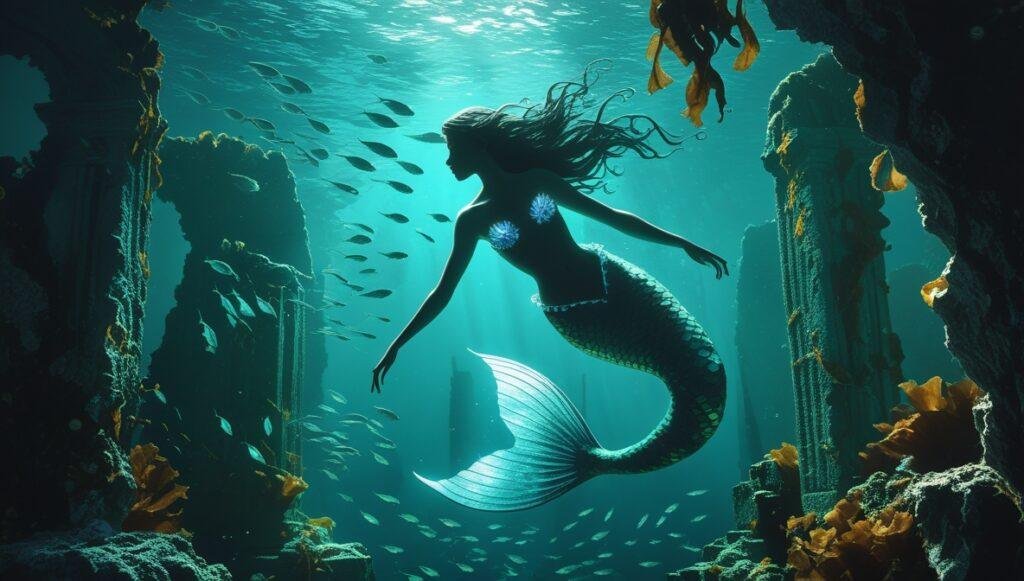
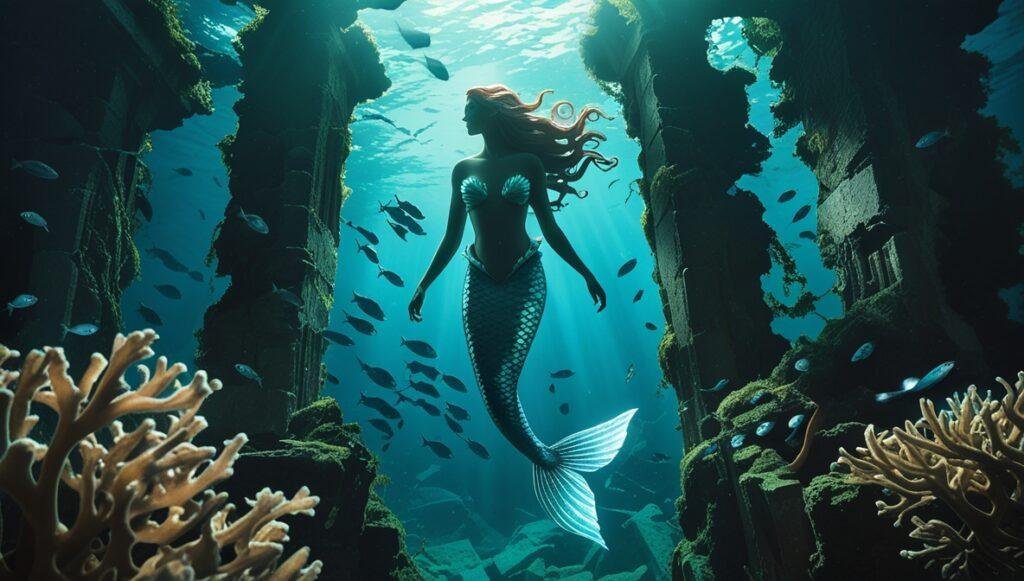
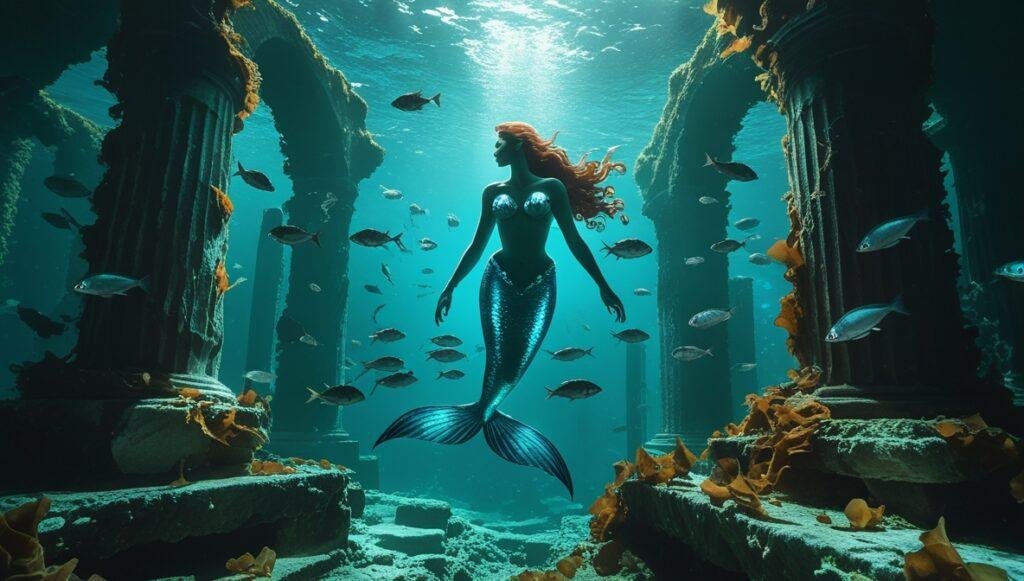
Where Would They Be Now?
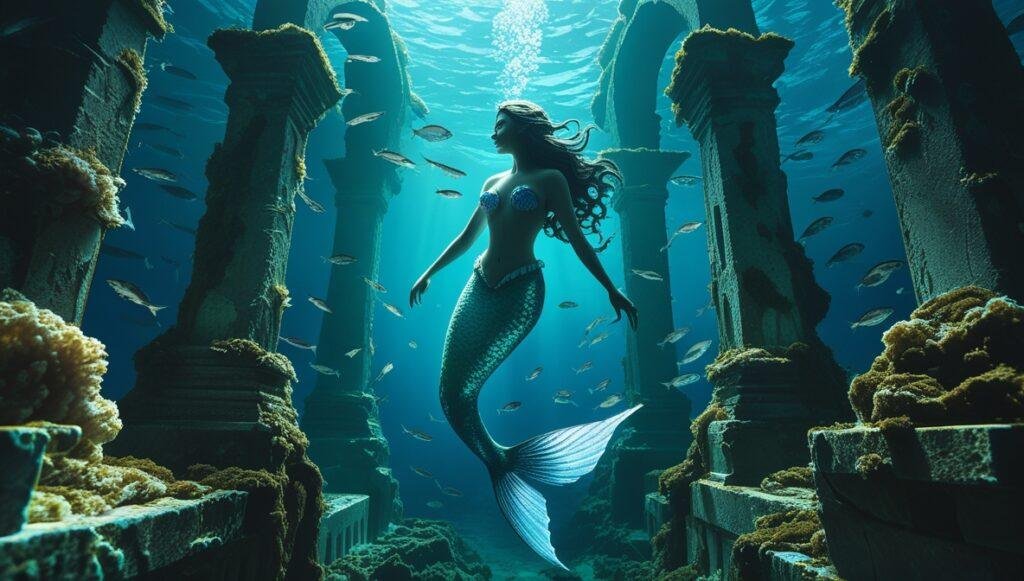
Here’s the unsettling truth: more than 80% of our oceans remain unexplored. We know more about the surface of Mars than about the trenches of our own planet. If an intelligent aquatic species existed, the deep sea would be the perfect place to hide.
The Mariana Trench alone is nearly seven miles deep. The pressure there is enough to crush submarines, and sunlight never reaches it. What else might be down there, alive but unseen, preserving the memory of an age before humanity ruled the world?
Some ocean researchers have even captured unexplained sounds, like the “Bloop” recorded by NOAA in 1997—so loud and organic that, for years, scientists couldn’t explain what made them. Could those mysterious sounds be echoes of something still swimming in the darkness?
Could They Still Exist Today?
If mermaids (or something like them) survived extinction and remained hidden, they would likely have evolved to adapt even further, perhaps communicating through low-frequency vibrations, blending into coral reefs, or living near geothermal vents where life thrives without sunlight.
Maybe they watch us even now, curious from a distance, wondering how their land-dwelling cousins turned the world above into noise, fire, and chaos.
Key Points to Consider
- Cross-Cultural Legends: Mermaids appear in Greek, African, Japanese, and Norse mythologies, indicating shared human memory.
- Scientific Theory Connection: The aquatic ape hypothesis gives a biological framework for such beings.
- Historical Records: Early explorers, including Columbus, documented humanoid sea creatures.
- Unexplored Oceans: More than 80% of our seas are still unknown, perfect for hiding an ancient species.
- Unexplained Evidence: Mysterious underwater sounds and deep-sea anomalies keep the mystery alive.
Our Thoughts
Maybe mermaids weren’t ethereal songstresses sitting on rocks after all. Maybe they were intelligent, evolved beings, our distant cousins, watching our rise from the depths until they decided to disappear.
Or perhaps mermaids are just mirrors—reflections of our longing for freedom, beauty, and connection to the wild parts of the world we’ve forgotten.
Whatever the truth, one thing feels certain: the ocean still hides stories too big for us to imagine.
🔗 Related Articles from EdgyThoughts.com
🌐 External Resource
Want to explore mermaid folklore through history? Read more here:
https://en.wikipedia.org/wiki/Mermaid
One Comment
Comments are closed.