What if darkness is the universe’s true state?
What if darkness is the universe’s true state?
We grow up thinking light is normal.
Stars shine. Suns burn. Screens glow. Life feels bright, active, visible. Darkness feels like the absence, the pause, the failure of something else to exist.
But the universe tells a very different story.
When you zoom out far enough, strip away human bias, and look at reality on its own terms, an unsettling idea begins to form:
What if darkness is not the exception?
What if darkness is the universe’s true state, and light is the temporary anomaly?
This thought changes everything. Not just how we see space, but how we understand existence itself.
Most of the Universe Is Already Dark
Let’s start with something simple and undeniable.
The overwhelming majority of the universe is dark.
Not metaphorically. Literally.
- Most space contains no stars
- Most matter is invisible dark matter
- Most energy is dark energy
- Most regions are cold, silent, and empty
- Light-filled galaxies occupy a tiny fraction of cosmic volume
If you removed all light-emitting objects, the universe would not look broken. It would look normal.
Light is rare. Darkness is common.
From a cosmic perspective, brightness is the interruption.
Darkness Came Before Light
Before the first stars ignited, the universe spent hundreds of millions of years in total darkness.
No suns.
No galaxies.
No glowing skies.
Just expanding space, cooling matter, and silence.
That era was not a mistake. It was not a failure. It was the universe in its default condition.
Light appeared later, briefly, locally, and under very specific conditions.
If darkness was the starting point, and darkness will likely dominate the end, then light may be nothing more than a phase.
A spark in a much longer night.
The Future of the Universe Is Dark
Every serious long-term model of the universe points toward darkness.
Stars burn out.
Galaxies drift apart.
Energy spreads thin.
Matter decays.
Eventually, the universe becomes cold, dark, and quiet again.
Not destroyed.
Not collapsed.
Just dark.
This suggests something important.
Darkness is not what happens when things go wrong.
Darkness is what happens when things finish.
It is the stable state.
Our Bias Toward Light
Humans associate light with safety, knowledge, and life because we evolved under a star.
Our eyes depend on light.
Our brains rely on visible cues.
Our survival favors brightness.
So we assume light equals reality.
But that assumption is local, not universal.
The universe does not care what our senses prefer.
From its point of view, light is expensive. It requires fusion, structure, and constant energy loss. Darkness costs nothing. It is efficient. Stable. Enduring.
If the universe had preferences, darkness would be the logical choice.
Light Needs Conditions, Darkness Does Not
Light requires:
- Massive stars
- Nuclear fusion
- Balanced gravity
- Long chains of cosmic accidents
Darkness requires nothing.
Remove energy, and darkness remains.
Remove matter, and darkness remains.
Remove observers, and darkness remains.
Darkness does not depend on anything else to exist.
That alone suggests it may be more fundamental than light.
Dark Matter and Dark Energy Support the Idea
The universe is not just dark visually. It is dark structurally.
Dark matter holds galaxies together.
Dark energy drives cosmic expansion.
Visible matter is along for the ride.
Whatever the universe truly is made of, it is not the glowing part.
The glowing part is decoration.
Darkness is the framework.
Darkness as a Natural State of Reality
What if darkness is not emptiness, but neutrality?
A baseline state where:
- No energy is flowing
- No information is broadcasting
- No structure is forced into existence
Light disrupts darkness.
Matter disrupts darkness.
Life disrupts darkness.
But disruption is temporary.
Darkness always reasserts itself.
Not violently.
Quietly.
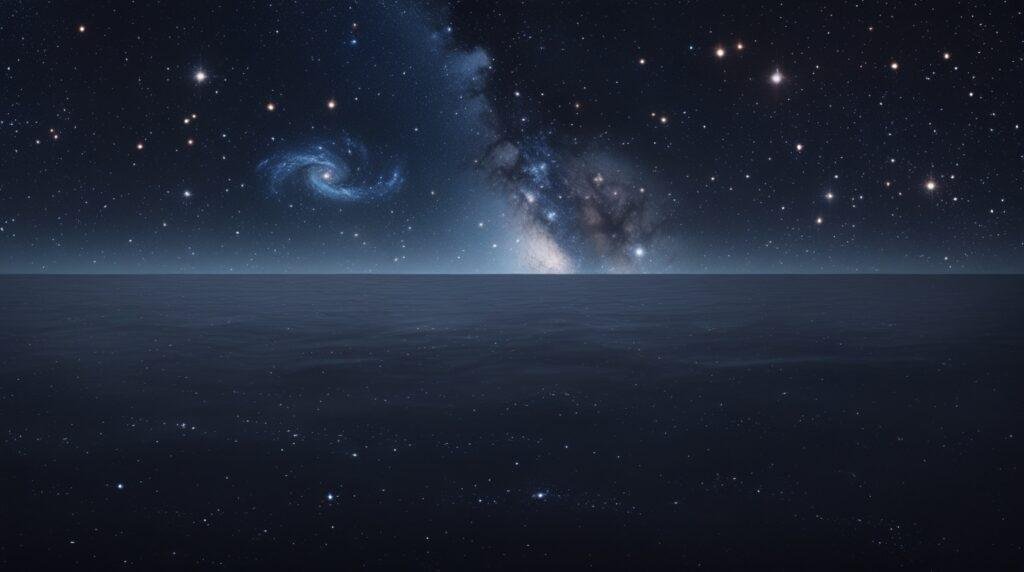
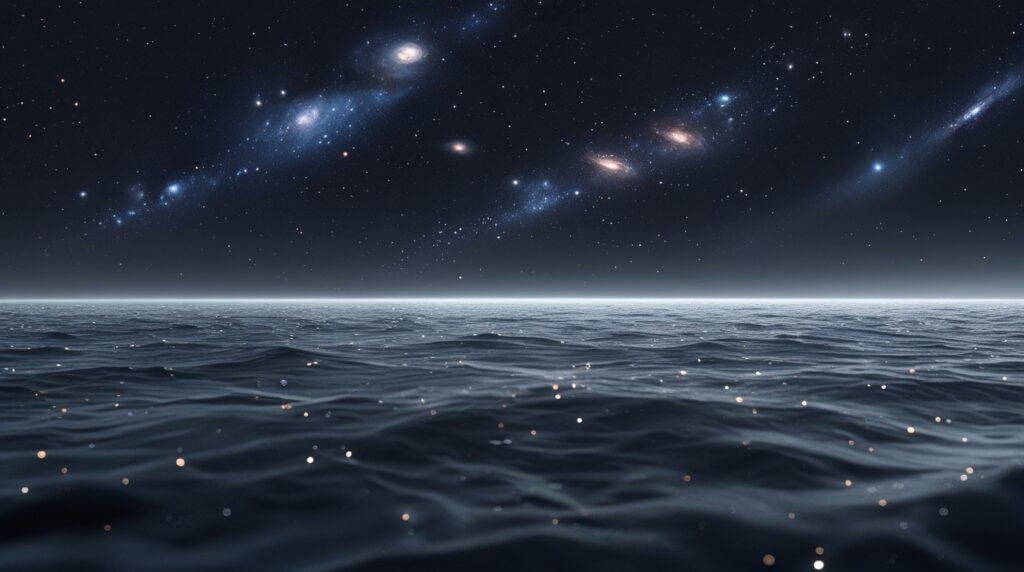
Could Darkness Be the Canvas of Existence?
In art, the canvas matters more than the paint.
In music, silence gives meaning to sound.
What if darkness plays the same role in the universe?
A background that:
- Allows contrast
- Enables structure
- Absorbs excess
- Stabilizes extremes
Without darkness, light would have no context.
Without darkness, time would have no rest.
Perhaps darkness is not absence, but support.
Consciousness and Darkness
Human consciousness behaves strangely in darkness.
- Dreams emerge
- Imagination deepens
- Time feels distorted
- Boundaries soften
Darkness turns the mind inward.
Perhaps that mirrors something larger.
If consciousness is tied to the universe in any deep way, maybe darkness is where awareness is most natural, not least.
Light demands attention outward.
Darkness invites presence.
Ancient Cultures Already Knew This
Across history, darkness was not always feared.
- Creation emerged from darkness in many myths
- The void was sacred, not empty
- Night was a source, not a threat
- Darkness preceded gods, worlds, and time
Only later did darkness become associated purely with danger.
Ancient intuition may have recognized something modern thinking forgot.
That darkness is not the enemy of existence.
It is its foundation.
What If Light Is the Illusion?
This is the most unsettling version of the idea.
What if light is not revealing reality, but distracting us from it?
Light is noisy.
Bright.
Chaotic.
Short-lived.
Darkness is quiet.
Stable.
Persistent.
What if the true structure of reality exists in what we cannot see, not what we can?
And what if our obsession with light has blinded us to the deeper nature of existence?
Key Points
- Most of the universe is dark, not light-filled
- Darkness existed before stars and will remain after them
- Light requires rare, temporary conditions
- Dark matter and dark energy dominate reality
- Darkness is stable, light is fleeting
- Human preference for light is evolutionary, not universal
- Darkness may be the universe’s default condition
Our Thoughts
If darkness is the universe’s true state, then existence is not about constant activity, brightness, or expansion.
It is about balance.
Light flares briefly, creates complexity, then fades. Darkness receives it all, holds it, and remains.
That does not make darkness empty.
It makes it patient.
The universe may not be racing toward light or meaning or progress. It may simply be returning to itself, over and over again.
And maybe the reason darkness unsettles us is not because it is dangerous.
But because it is honest.