What if darkness hides ancient cosmic beings?
What if darkness hides ancient cosmic beings?
When we talk about the universe, we usually talk about what we can see. Stars. Galaxies. Explosions of light. Bright things feel important, so we focus on them. But the truth is uncomfortable and easy to forget:
Light is the exception. Darkness is the rule.
Most of the universe is not glowing. It is not loud. It is not active in ways we easily notice. It is cold, vast, ancient, and quiet. And that raises a question that feels unsettling the longer you sit with it:
What if darkness doesn’t mean empty?
What if it means hidden?
What if the universe’s darkness is not a backdrop, but a veil?
Darkness Came First
Before stars existed, before galaxies formed, before light filled space, the universe was dark. For hundreds of millions of years after the Big Bang, there were no suns, no glowing skies, no familiar landmarks. Just expanding space and cooling matter.
Darkness is not a later addition to the universe.
It is the original condition.
If anything ancient exists in the cosmos, logic suggests it would come from that era, not ours. Any beings born before stars would not rely on light, heat, or chemistry the way we do. They would evolve in silence, pressure, gravity, and time.
To us, they would feel impossible.
To the universe, they would be natural.
Darkness Is Where Physics Breaks
The darkest places in the universe are also where our understanding collapses.
Black holes erase information, bend time, and trap light.
Cosmic voids stretch across millions of light-years with barely any visible matter.
Dark matter and dark energy dominate everything without revealing their nature.
These regions are not just dark.
They are unknown.
If something ancient wanted to exist unnoticed, darkness would be the perfect environment. Not because it hides visually, but because it hides conceptually. We do not know how to ask the right questions about dark regions yet.
And what we cannot ask about, we cannot find.
Life Does Not Need Light
We often assume life requires sunlight, warmth, and chemistry similar to Earth. But even on our own planet, that assumption is already broken.
Deep-sea organisms thrive without sunlight.
Extremophiles survive radiation, acid, and crushing pressure.
Microbes live inside rocks, ice, and volcanic vents.
If life can exist in darkness on Earth, why not in cosmic darkness, where conditions have been stable for billions of years?
An ancient cosmic being would not resemble biology as we know it. It might not have cells or DNA. It could exist as:
- Gravitational patterns
- Energy fields
- Spacetime structures
- Information flows
- Long-lived configurations of dark matter
To us, it would look like a law of physics.
Dark Matter as a Habitat
Dark matter makes up most of the universe’s mass. It shapes galaxies, forms invisible scaffolding, and persists everywhere.
But we still do not know what it is.
Some speculative theories suggest dark matter could support complexity at scales and forms we cannot perceive. Not particles bouncing like atoms, but slow, massive, stable arrangements that evolve over cosmic time.
If ancient beings exist, dark matter would be a perfect medium:
- Invisible to light
- Stable over billions of years
- Immune to stellar explosions
- Present before stars existed
Such beings would not live in darkness.
They would be made of it.
Ancient on a Scale We Cannot Imagine
Human history spans thousands of years. Cosmic history spans billions.
If something formed shortly after the universe cooled enough to stabilize, it would be older than:
- All stars
- All planets
- All life as we know it
Such beings would not rush. They would not react. They would not communicate in moments or years. Their actions might take millions of years to unfold.
To us, that looks like inactivity.
But slowness is not absence.
Mountains move. Continents drift. Galaxies collide.
Time just hides motion when it stretches long enough.
Why We Would Never Recognize Them
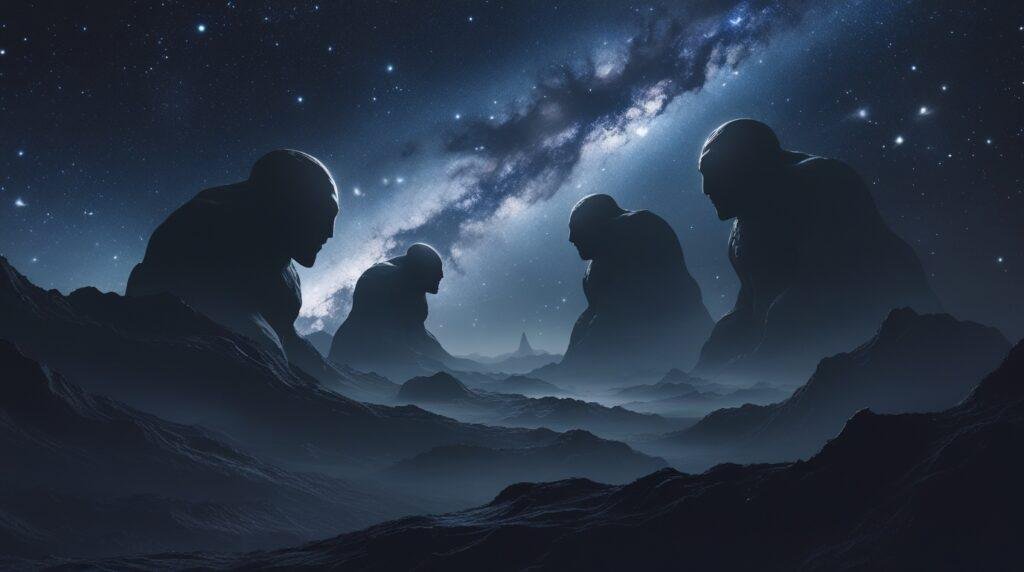
If ancient cosmic beings exist in darkness, we would likely mistake them for natural forces.
Gravity would be their movement.
Expansion would be their influence.
Structure formation would be their footprint.
We already do this. We label unexplained behaviors as:
- Dark energy
- Dark matter
- Vacuum fluctuations
- Background fields
Naming something does not mean understanding it. Sometimes it only means we have decided to stop asking deeper questions.
Consciousness Without Minds
When people imagine cosmic beings, they picture intelligence, intention, and thought. But awareness does not have to resemble human thinking.
An ecosystem is aware in how it responds to imbalance.
A star “knows” when to collapse based on internal forces.
A galaxy maintains structure through invisible interactions.
Awareness at a cosmic scale could be:
- Distributed
- Non-local
- Non-emotional
- Non-communicative
Not a mind watching us.
A system maintaining itself.
Ancient cosmic beings might not observe us at all. We may be too small, too fast, too temporary to matter.
Myths Might Be Memory, Not Fantasy
Ancient cultures across the world spoke of beings born from darkness:
- Watchers older than the stars
- Creators emerging from void
- Silent gods who shaped reality indirectly
We often dismiss these stories as metaphor. But myths frequently preserve truths in symbolic form when literal understanding is impossible.
Perhaps early humans sensed something real. Not visually, but intuitively. A feeling that the darkness was not empty, that something immense existed beyond perception.
Not evil.
Not benevolent.
Just ancient.
Why Darkness Feels Unsettling
Darkness triggers fear not because it is dangerous, but because it removes certainty. You cannot see boundaries. You cannot predict outcomes.
And ancient cosmic beings, if they exist, would represent the ultimate loss of certainty. Not monsters, not invaders, but proof that the universe is deeper and older than anything we control.
Darkness reminds us that knowledge is local.
Ignorance is cosmic.
Key Points
- Darkness dominates the universe, not light
- The oldest regions of existence were lightless
- Life does not require light or familiar biology
- Dark matter and voids provide stable, ancient environments
- Cosmic-scale beings would act too slowly to notice
- We may mistake living systems for physical laws
- Myths may echo intuitive awareness of ancient forces
Our Thoughts
If darkness hides ancient cosmic beings, they are not waiting to be discovered. They are not hiding from us. They simply exist on a scale that makes discovery meaningless.
They do not watch humanity.
They do not interfere.
They do not care.
And that may be the most honest form of cosmic life imaginable.
Not gods.
Not monsters.
Just ancient presences, woven into the structure of reality itself, existing quietly while stars rise and fade around them.
The universe may not be empty.
It may simply be older than our curiosity.