What if black space regions erase reality?
What if black space regions erase reality?
There are places in the universe where light does not return.
Not because it is blocked, but because it is gone.
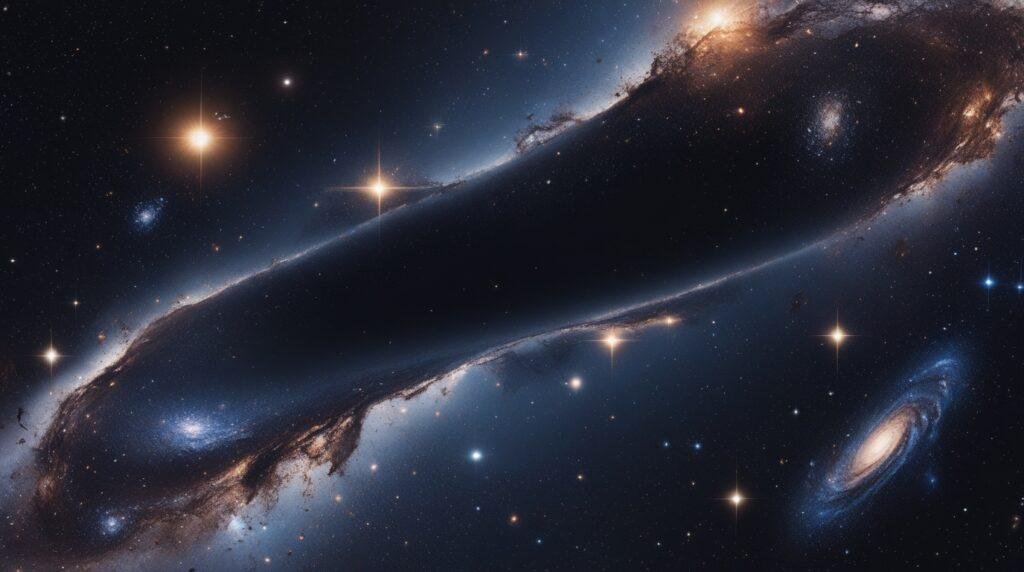
When astronomers map the cosmos, they do not just find stars and galaxies. They find vast regions of darkness, zones so empty, so silent, and so gravitationally strange that they feel less like space and more like absence.
These are not black holes.
They are not nebulae.
They are not simply empty gaps.
They are black space regions, places where something feels missing.
So here is the unsettling question we almost never ask directly:
What if some regions of space do not just hide reality, but erase it?
Not destroy it violently.
Not consume it loudly.
But quietly remove it from existence.
Black Space Is Not Normal Space
We tend to think of space as uniform. Same laws everywhere, same behavior everywhere. But observations suggest that is not entirely true.
There are regions where:
- Matter density drops dramatically
- Time behaves oddly
- Gravity weakens or distorts unexpectedly
- Light bends or fades without a clear source
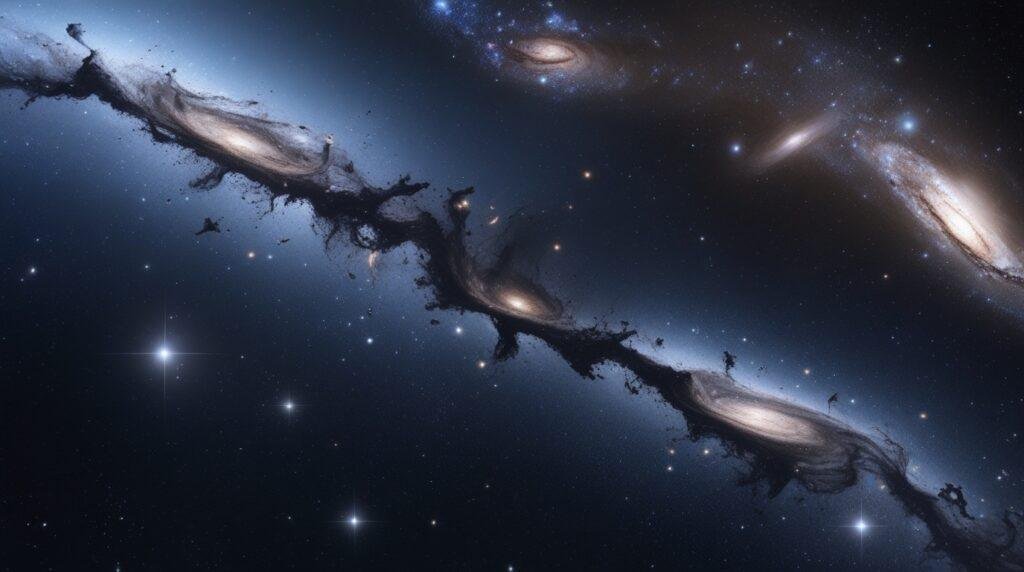
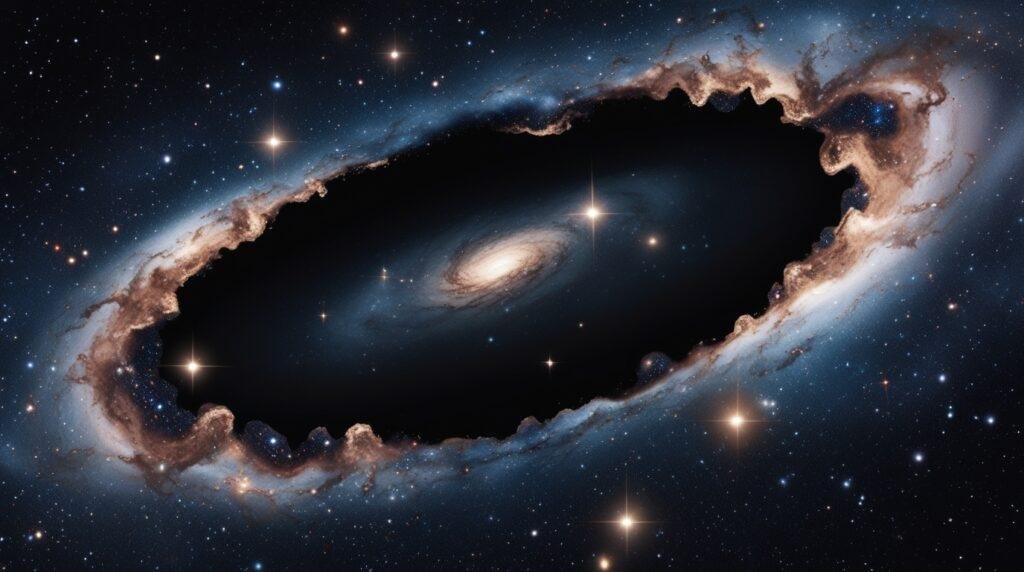
Cosmic voids can stretch hundreds of millions of light-years. Inside them, galaxies are rare, motion is slow, and interactions are minimal.
These places feel less like “empty space” and more like unfinished reality.
What if space itself is not equally real everywhere?
What Does It Mean to Erase Reality?
Erasing reality does not have to mean annihilation.
It could mean:
- Removing definition
- Collapsing structure into pure potential
- Stripping matter of interaction
- Dissolving time, causality, or identity
In physics, reality exists because things interact. Particles interact. Fields interact. Forces interact.
If interaction stops, reality becomes meaningless.
A black space region that prevents interaction would not kill reality. It would unmake it.
Like a sentence erased from a book, not burned, just removed as if it never existed.
Beyond Black Holes, Darker Than We Know
Black holes already challenge reality. Inside them, space and time swap roles, information becomes trapped, and known physics fails.
But black holes are still structured. They have mass, boundaries, and measurable behavior.
Black space regions could be different.
They may not collapse matter.
They may not pull violently.
They may simply cause reality to thin out.
A place where:
- Time stops being meaningful
- Objects lose persistence
- Cause and effect dissolve
- Identity fades
To us, that would look like nothing.
But nothing is not the same as erased.
Quantum Reality Can Already Disappear
At the quantum level, particles exist only when observed. Without observation, they revert to probability, not presence.
Reality at its smallest scale already behaves like it can turn off.
Now imagine that behavior scaled up.
What if black space regions prevent observation entirely?
No interaction. No measurement. No collapse into reality.
In such a place, existence might remain permanently unreal.
Not dead.
Not destroyed.
Just unresolved.
The Universe Might Have Deletion Zones
The universe is expanding. Space itself stretches. Matter thins. Energy disperses.
What if, beyond a certain threshold, space becomes unable to support structure?
Like data stretched too thin across a corrupted drive.
These black regions could be cosmic deletion zones, where:
- Complexity cannot survive
- Information disperses beyond recovery
- Structure dissolves into noise
Not violently.
Quietly.
The universe would not scream.
It would forget.
Could Reality Be Locally Stable Only?
We assume the laws of physics are universal. But what if they are locally enforced?
What if reality only holds together in regions dense enough to support interaction, like galaxies and clusters?
Outside those regions, reality could weaken.
Not collapse, but lose coherence.
Think of fog thinning until shapes no longer form.
Think of sound fading until meaning disappears.
Black space regions might be places where the universe no longer has enough structure to maintain itself.
Time Might Die There First
Time depends on change.
Change depends on interaction.
If interaction fades, time loses meaning.
In black space regions:
- No clocks would tick
- No events would sequence
- No before or after would exist
An object entering such a region might not be destroyed.
It might simply stop having a timeline.
From the outside, it would look erased.
From the inside, there may be no experience at all.
Why We Would Never See It Happen
Reality erasing reality would leave no evidence.
No explosion.
No radiation.
No signal.
Just absence.
An object disappears, not into darkness, but into non-definition.
We would assume it drifted away, faded, or was never there at all.
That is the most unsettling part.
If reality can be erased cleanly, we would never know it happened.
Ancient Myths Hint at Consuming Voids
Across cultures, myths speak of:
- Devouring darkness
- Bottomless voids
- Regions beyond existence
- Places where things are unmade
These are often dismissed as symbolic fear of the unknown.
But symbolism often forms when the mind senses something real but cannot describe it.
Perhaps humans have always sensed that some parts of the universe are not safe for existence itself.
Not because they are hostile.
But because they are empty of meaning.
Consciousness Might Not Survive Erasure
If black space regions erase reality, consciousness would not escape.
Consciousness depends on structure, memory, and continuity. Without interaction, there is no awareness.
Entering such a region would not feel like death.
It would feel like nothing at all.
No fear.
No darkness.
No experience.
Just absence.
And that idea is far more unsettling than any cosmic monster.
Key Points
- Some regions of space are vastly emptier than others
- Reality depends on interaction and structure
- Quantum physics already shows reality can vanish without observation
- Black space regions may dissolve interaction entirely
- Time and identity may not survive in such zones
- Erasure would leave no detectable evidence
- The universe may contain areas where existence cannot persist
Our Thoughts
If black space regions erase reality, then existence is not guaranteed everywhere.
Reality would be fragile.
Local.
Temporary.
Not because the universe is hostile, but because it is indifferent.
And perhaps that is the quiet truth hidden in the darkness.
The universe does not protect reality.
It only allows it where conditions are right.
Outside those conditions, reality does not end.
It simply stops being.