Is reality more illusion than truth?
Is reality more illusion than truth?
There’s something both thrilling and unsettling about this question, because it pokes at the very foundation of everything we believe to be real. The chair beneath you, the screen in front of you, the thoughts running through your head, they all feel solid, familiar, and true. But what if they’re not? What if everything we see, hear, and touch is only a thin layer of illusion, a trick of perception, biology, or even something more cosmic?
From ancient philosophers to quantum physicists, the idea that reality may be an illusion has haunted human thought for centuries. But in the 21st century, with technology capable of bending truth and science revealing the strangeness beneath existence, the question feels more urgent than ever.
So, let’s peel back the layers and see what’s really behind the curtain.
🧠 The Mind Creates Its Own Reality
Your brain isn’t a mirror of the world, it’s a storyteller.
Every second, it receives billions of bits of sensory information, light, sound, texture, taste, and throws most of it away. What’s left is stitched together into a version of the world that makes sense to you. You don’t actually see reality; you see what your brain thinks reality should look like.
It’s like living inside a simulation generated by your own neurons.
- Colors? They don’t exist in the world, only wavelengths of light that your brain translates into “blue” or “red.”
- Sound? Just air vibrations turned into meaning.
- Time? A mental construct to organize experience.
The truth is, what you perceive as real is already a filtered, edited projection inside your mind.
So, if perception can’t be trusted, can reality?
🪞 Philosophers Have Been Asking This Forever
Humans have wrestled with this question for thousands of years.
- Plato’s Allegory of the Cave describes prisoners chained inside a cave, watching shadows on a wall and mistaking them for reality. When one escapes and sees the real world, the others refuse to believe him.
- Descartes asked, “How can I know anything is real?” and concluded, “I think, therefore I am.”
- Buddhist philosophy teaches that the material world is maya, an illusion created by attachment and perception.
- And modern thinkers like Jean Baudrillard suggested that our entire culture has become a simulation, where media, technology, and symbols replace truth.
It’s a question that refuses to die, because every generation finds new reasons to doubt what it means to be real.
🧬 Science Joins the Conversation
Philosophy used to own this question, but now science has entered the game, and the answers are even weirder.
1. Quantum Mechanics: Reality at Its Strangest
At the subatomic level, things don’t behave like “things” at all. Particles can exist in multiple states at once, and only “choose” one when observed. This is called the observer effect.
That means your observation helps determine reality. Until you look, everything exists in a kind of potential fog.
In other words: the universe might literally not “settle” into being until someone perceives it.
2. Simulation Theory
What if everything, from galaxies to human emotions, is part of a grand simulation?
Some scientists, like Nick Bostrom, argue that if advanced civilizations could create simulations indistinguishable from reality, we might already be living in one.
Even Elon Musk once said the odds we’re living in “base reality” are “one in billions.”
Every digital pixel, every algorithmic pattern, and every quantum uncertainty could be part of the code that makes up our existence.
3. The Brain-in-a-Vat Hypothesis
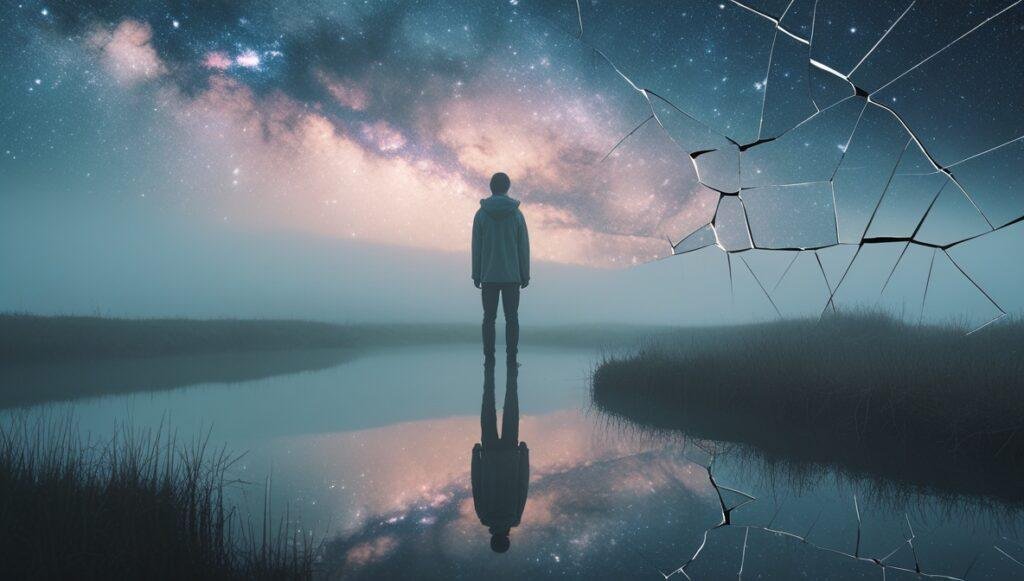
Imagine your brain sitting in a jar, connected to a computer that feeds it perfectly simulated sensory experiences. How would you know the difference between that and real life?
You wouldn’t. And that’s the point, your reality depends entirely on perception.
🕰️ Reality Feels Real; But Memory Doesn’t
Even our memories, those sacred archives of truth, can’t be trusted. Neuroscience has proven that memory is reconstruction, not replay. Each time you recall an event, your brain slightly alters it, reshaping the story to fit how you feel now.
Over time, the truth gets blurred. So even our past isn’t stable, it’s an illusion we agree to believe.
If both perception and memory can deceive us, then how solid can “truth” really be?
🌌 Maybe “Reality” Is Just a Shared Dream
What if everything we experience is part of a collective illusion, a shared dream that all conscious beings participate in? Some physicists believe the universe might be conscious itself, and that reality emerges from information and observation rather than matter.
In that case, truth isn’t something out there; it’s something we co-create every moment.
Your mind, my mind, and the universe are all playing the same game:
to pretend that the illusion of stability is real enough for us to live in.
💭 Our Thoughts
So, is reality more illusion than truth?
Maybe. But maybe that’s not a bad thing.
If reality is shaped by perception, then every thought, every dream, every belief adds color to the canvas. Maybe the illusion is the truth, a constantly shifting story we tell ourselves to make sense of existence.
After all, maybe the point isn’t to see what’s “real.”
Maybe it’s to wake up inside the illusion, and realize we’re the ones creating it.
🔗 Related Articles from EdgyThoughts.com
🌐 External Resource
Explore more about the nature of perception and reality here:
https://en.wikipedia.org/wiki/Philosophy_of_perception
One Comment
Comments are closed.